Legal-services website · Operations demonstration · Panama
Carolina Solís.Clearer client journeys.
Two distinct pieces of work for a legal practice: a published website that explains the services and consultation routes, and a legal-operations platform built and tested with synthetic data in staging. The platform demonstrates how enquiries, intake, documents and expert review could connect.
The business problem
Clear services.
Better-prepared enquiries.
The project addresses a familiar legal-service problem: prospects need to understand the service, choose a consultation route and know what information to prepare.
Incomplete intake, missing documents and repeated status questions can create extra preparation work. These are the workflow problems the staging platform is designed to address.
The controlled staging demonstration connects that journey to show how a team could receive clearer enquiries, better inputs, visible next actions, and matters organized for review.
01 / Published website
See the services.
Choose a next step.
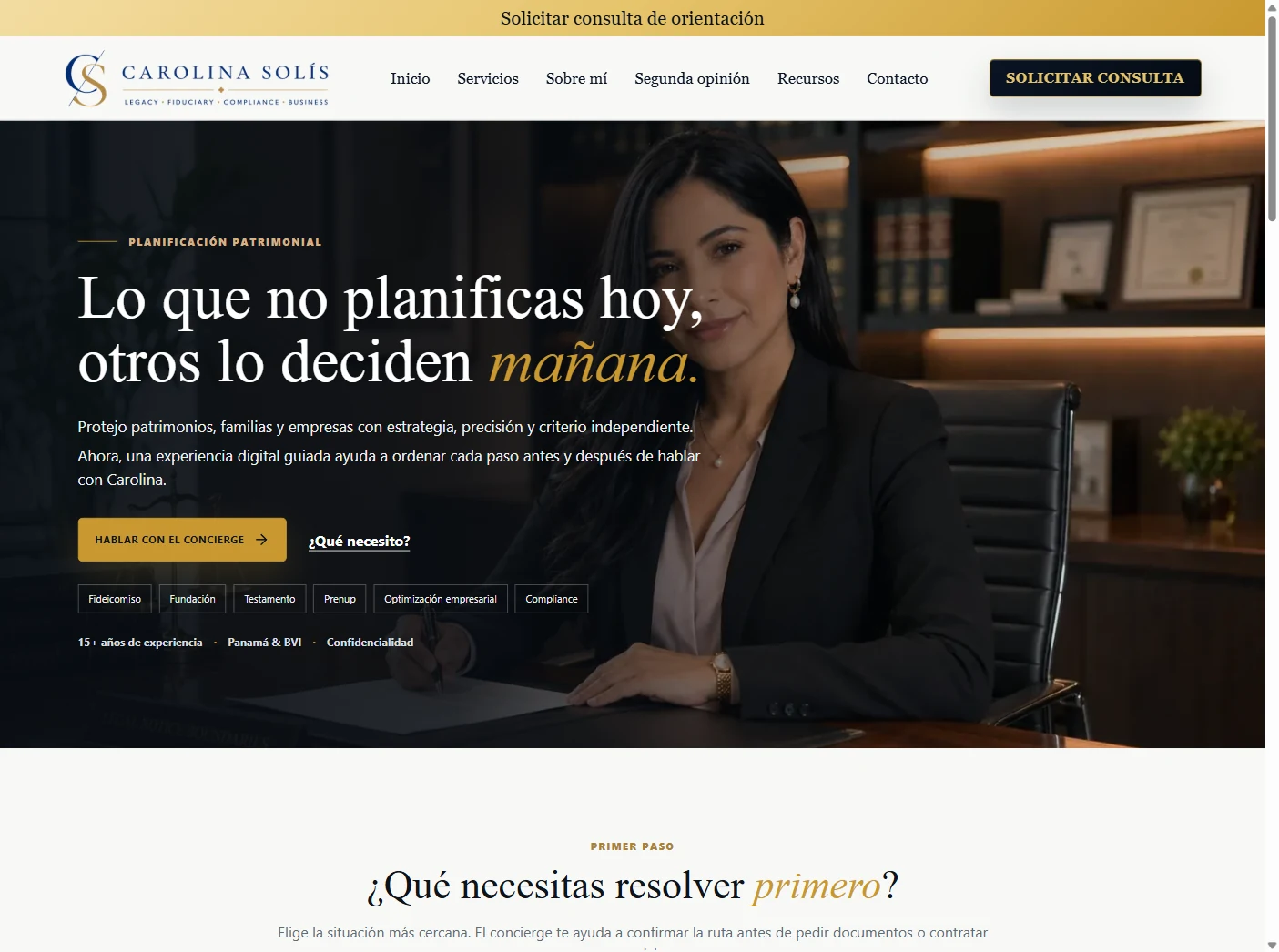
The public website presents Carolina’s legal service categories and a route to request a consultation. This delivered website is separate from the staging platform shown below.
Lead response and qualification
Inside the staged platform.
In controlled staging, the AI concierge demonstrates a guided first step, need identification, and a structured handoff for the team.

The business system
Six connected functions
Lead response
Staging demonstrates AI chat and voice answering approved questions and capturing intent.
Qualification
The staged system demonstrates fit identification, routing, and contextual handoff.
Client intake
Synthetic intake steps demonstrate collecting required context and exposing gaps.
Document operations
Synthetic files demonstrate checks, processing states, organization, and matter links.
Work preparation
The demonstration organizes facts, open questions, sources, risks, and draft work for review.
Delivery control
The staged controls keep expert review mandatory and make progress and next actions visible.
Visible staging demonstration
What the system is designed to support
Product screens from the controlled staging environment show the intended operation at each stage; they are not production-usage or client-result evidence.


The automated client journey
From lead to review-ready
Select a stage to see how the controlled staging system is designed to turn an enquiry into useful work for the team.
Staged operating model
One connected demonstration.
Explore the six-step workflow
Enquiry captured
The staged flow demonstrates an approved first response to a synthetic enquiry.
Fit identified
The demonstration organizes the need, service route and conversation context.
Intake completed
The system collects required information and exposes gaps before work begins.
Documents organized
Files, quality issues, replacements, processing, and history remain visible.
Work prepared
The staging demonstration assembles synthetic facts, source material and open questions for review.
Expert review
The qualified professional reviews, revises, approves, and delivers the final work.
Intended operational value
What the design aims to change
The design aims to handle approved first questions and qualification before manual review.
The design makes missing information, document states, and actions visible.
The staged workflow organizes context, files, source material, and open questions for review.
The staged operating view demonstrates status, responsibility, progress, and next actions.
The design keeps expert review mandatory before any final professional delivery.
Evidence status: the connected system and its controls were built and tested with synthetic data in controlled staging. External provider actions are disabled. This page does not claim production adoption, real client usage, revenue increase, time saving, or client-volume uplift. The separate public marketing website is live.
Common questions.
What business problem does this solve?
It connects the work that normally happens across forms, inboxes, chat, documents, payment tools, spreadsheets, and staff follow-up. The intended result is a clearer journey from first enquiry to prepared expert work; production impact remains unmeasured.
Where does AI create value?
The staging design applies AI to repetitive preparation layers: immediate response, qualification, completeness checks, document processing, information organization, source retrieval, open-question detection, and draft preparation.
What could change for the team?
The design aims to reduce repetitive triage, missing-information follow-up, document-status checks, context reconstruction, and manual updates. Those operating effects require a supervised production pilot before they can be claimed as client results.
Does AI replace the legal professional?
No. AI prepares and organizes work. Legal judgment, revisions, approval, and final delivery remain with the qualified professional.
Can this architecture be adapted for another business?
Potentially. The architecture can be scoped for clinics, consultancies, financial services, property businesses, and other expert-led firms, but each implementation needs its own approved rules, privacy review, provider testing, and production evidence.
Is this live in production?
The public marketing website is live. The separate AI concierge, structured intake, document workflow, client portal, operations layer, and expert-review controls form a connected staging demonstration tested with synthetic data. External provider actions are disabled, so it is not presented as an adopted production client workflow.
Is this the right fit?
When it fits
Enquiries lack direction
Prospects need clarity before they choose a service or share private information.
Cases feel fragmented
Intake, documents, payments, status, and review sit in disconnected tools.
Legal judgment stays human
Automation organizes the journey without replacing professional judgment.
Bring your client workflow.
Find the next step.
Show us where enquiries, intake or documents become difficult to manage. We’ll discuss what could be clearer, what needs checking and whether we’re the right people to help.
Book a free discovery call
You’ll speak with the people behind the work. We’ll explain what we recommend, why it matters and what it will take to do it.
Meet Rich, founder ↗