AI agents
AI agents can answer common questions, collect intake details, qualify inquiries, summarize conversations, and hand off to a human when needed.
Service business systems
AI automation for service businesses is not about replacing your team with bots. It is about fixing the points where leads, clients, and staff lose time every day: slow replies, unclear intake, manual booking, missed calls, inconsistent follow-up, and scattered reporting.
Visitor path
If this page matches your business model, use the links below to choose a system, compare the full AI services hub, or buy a practical starter product.
Worked example
Illustrative workflow to review with your team; not a client result.
Example record
Appointments → confirmed/requested. Dispatch → assigned/unassigned. Quotes → review/sent/accepted. Each record retains its owner.
Sending a message does not complete a booking, dispatch a technician or accept a quote.
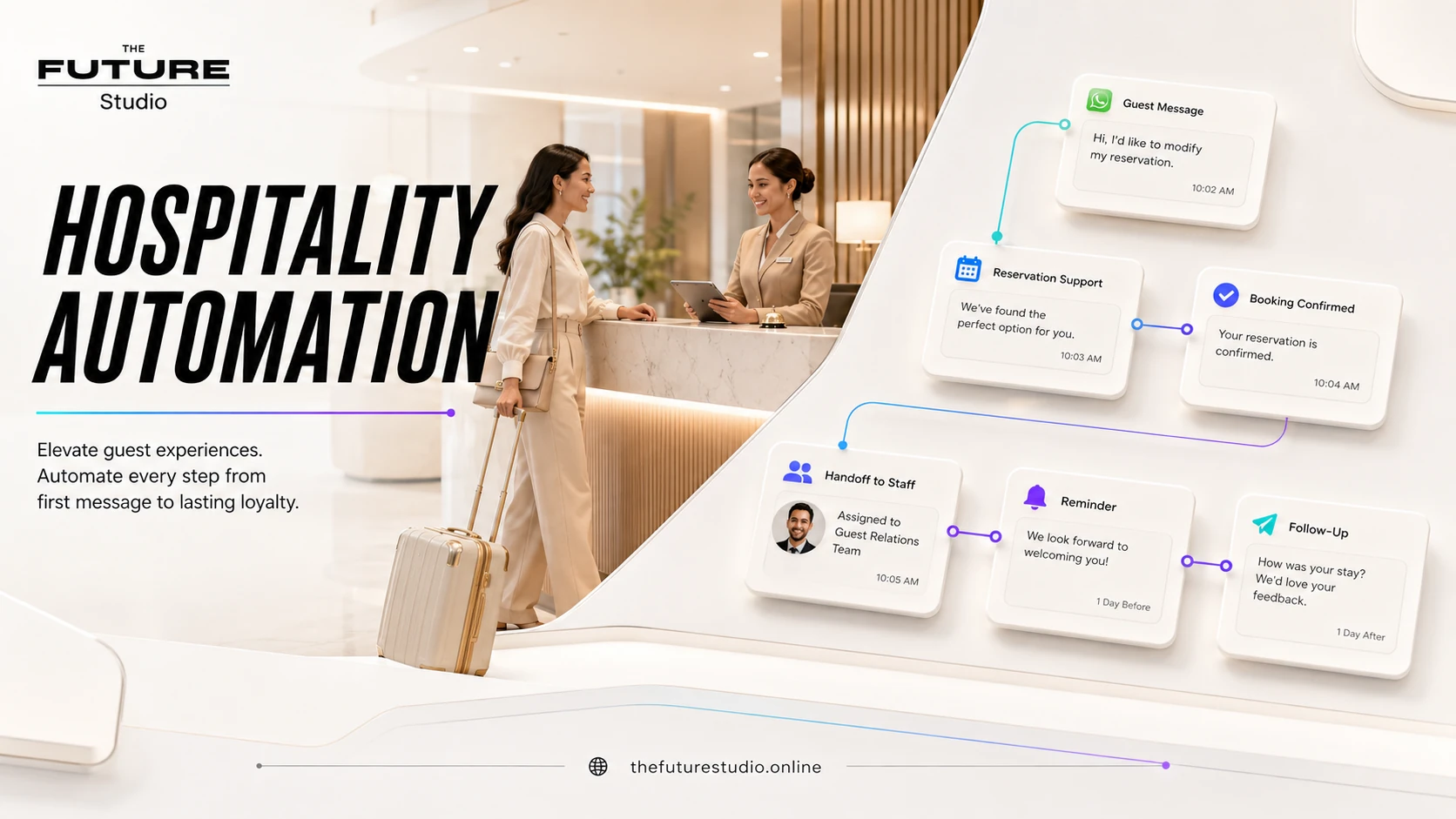
The best first automation is usually one repeated workflow that already costs time, leads, or staff attention every week.
The real problem
Most service businesses do not have a traffic problem first. They have a response problem, an intake problem, a follow-up problem, or a booking problem.
A potential client calls after hours, sends a WhatsApp message, fills out a website form, or asks a question through social media. The team is busy. The reply comes late. The lead goes cold. Even when the team eventually answers, the conversation may restart from zero because the details were not captured cleanly.
That is where AI automation services can help. When the system is designed around the way your business actually runs, it can improve first response, qualify leads, collect the right information, route conversations, support appointment booking, and keep follow-up consistent.
What it is
AI agents can answer common questions, collect intake details, qualify inquiries, summarize conversations, and hand off to a human when needed.
Automation can connect websites, WhatsApp, forms, calendars, CRM tools, spreadsheets, email, and dashboards so the next step is clearer.
A good system does not make regulated decisions, replace medical judgment, provide legal advice, or trap customers when they need a person.
Best fit
AI automation for service businesses is especially useful for companies that receive leads or client requests through calls, WhatsApp, websites, forms, email, or social media.
The common thread is simple. If your team answers the same questions, collects the same information, books appointments, follows up manually, or loses leads because response times are inconsistent, AI workflow automation can help.
Workflow targets
Respond instantly when someone submits a form, sends a WhatsApp message, or asks a basic question on your website.
An AI lead qualification agent can ask structured questions based on your business rules, such as service need, urgency, budget, location, or timeline.
WhatsApp automation for small business can answer FAQs, collect intake details, send links, confirm next steps, and route complex cases to the right person.
If a call is missed, automation can send a polite text or WhatsApp message so the lead has another path forward.
An AI booking agent can collect booking details, help people choose the right service, send confirmations, and reduce scheduling back-and-forth.
After a conversation, the system can summarize what happened, what the customer wants, what was promised, and what the next step should be.
Implementation
A serious build starts with workflow mapping. Before adding AI, you need to understand what happens from the moment a lead contacts the business to the moment they book, buy, or leave.
From there, the implementation should include approved scripts, business rules, FAQs, escalation logic, and clear instructions for what the AI agent can and cannot say. This is especially important for clinics, legal firms, financial services, and any business handling sensitive information.
Mistakes to avoid
The biggest mistake is automating before mapping the workflow. If your intake process is unclear, AI will only make the confusion faster.
Another mistake is using generic bot replies. Customers can tell when an answer sounds vague or disconnected from the business. Your AI agent should reflect your actual services, policies, tone, and process.
Businesses also need a clear human handoff. AI should never be the final stop for urgent, complex, emotional, or regulated situations. A good system knows when to step aside and gives the team a useful summary.
Finally, do not build automation without tracking outcomes. You should know whether response times improved, more leads were captured, more appointments were booked, or staff time was reduced.
Panama angle
In Panama, many service businesses depend heavily on WhatsApp, phone calls, referrals, and quick personal communication. Customers often expect fast replies, especially for appointments, real estate inquiries, hospitality, clinics, and local services.
Bilingual communication also matters. A customer may start in English and continue in Spanish, or the opposite. A well-planned AI system can support both languages while still following approved scripts and escalation rules.
For local companies competing with larger operators, faster response and better follow-up can make a real difference. AI automation gives smaller teams a way to manage more inquiries without lowering service quality.
The Future Studio approach
The Future Studio builds design-led AI systems around real business operations, not generic templates.
We start by understanding how your leads arrive, what your team does manually, where customers get stuck, and which workflow should be automated first. Then we design the system around your website, intake process, sales pipeline, booking flow, and team capacity.
Depending on the business, that may include website AI assistants, WhatsApp automation, voice agents, booking agents, lead pipeline automation, AI-powered content systems, custom apps, dashboards, internal tools, and team training.
As an AI workflow automation agency, our goal is not to add AI for the sake of it. The goal is to create a useful system your team can trust, manage, and improve over time.
FAQ
AI automation for service businesses uses AI agents and workflow tools to handle repeatable tasks such as first response, lead qualification, intake, appointment booking, reminders, follow-up, and internal summaries. It works best when it supports your team instead of replacing human judgment.
Start with the workflow that causes the most lost revenue or wasted time. For many businesses, that is missed lead response, WhatsApp inquiries, appointment booking, intake questions, or follow-up after a quote or consultation request.
Yes, if the system is built with approved answers, clear business rules, and a human handoff. WhatsApp automation can answer FAQs, collect information, confirm details, and route conversations. It should not guess, provide sensitive advice, or handle situations outside its scope.
No. Many AI systems for small business are focused on simple, high-value workflows. A small clinic, law office, real estate team, or home service company may benefit from automating one process before building more advanced systems.
Yes. An AI booking agent can help collect appointment details, check availability, send confirmations, and reduce back-and-forth messages. Some businesses may prefer staff approval before final confirmation, especially for complex services.
It should not be designed that way. A practical AI system handles repetitive steps so your team can focus on higher-value conversations, sensitive cases, client service, and closing qualified opportunities.
Related pages
Next step
The best way to start is to map one workflow. Book a free AI systems demo with The Future Studio and we will help identify the first workflow your business should automate, whether that is lead response, WhatsApp intake, appointment booking, follow-up, or internal task management.