ai voice agent for clinics and service businesses
AI Voice Agent for Clinics and Service Businesses
An ai voice agent for clinics and service businesses is most useful when missed calls turn into missed bookings, delayed intake, and messy follow-up. A good setup answers routine calls, captures the reason for the call, supports appointment requests, sends a same-language summary, and routes the next step to staff, WhatsApp, or a booking flow. For clinics and service businesses, the practical win is not sounding human. It is giving every caller a clear first response, bilingual routing when needed, and a clean human handoff when the request should not stay with AI.
What should an AI voice agent do for a clinic?
An AI voice agent should answer routine calls, recover missed calls, collect approved booking details, confirm critical information and send a concise summary to staff. It should transfer or escalate emergencies, symptoms, clinical questions, complaints and any call that falls outside the approved script.
Useful call types
- Appointment requests and confirmations.
- Hours, location and approved service FAQs.
- After-hours messages and callback requests.
Quality controls
- Repeat names, numbers and appointment details.
- Preserve language, source and urgency in the summary.
- Fail safely to transfer, alert or callback.
Visitor path
Choose the voice-agent next step
A visitor researching voice agents should be able to compare the system page, booking flow, clinic receptionist use case, and purchase path quickly.
Worked example
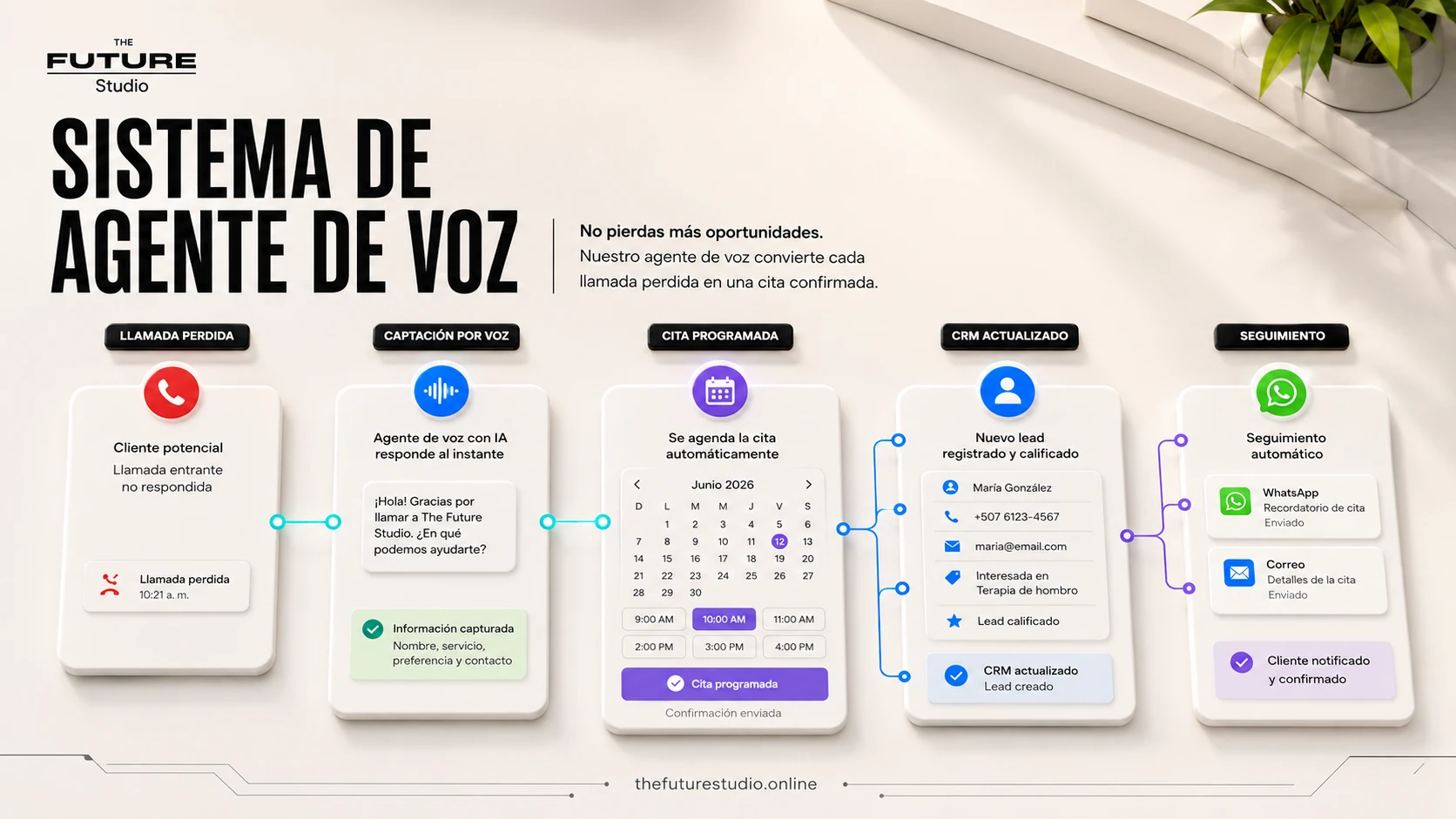
An annotated call-to-record flow
Illustrative workflow to review with your team; not a client result.
From request to action
- TriggerA caller asks about a service or appointment.
- Required informationIdentify the reason for calling and collect approved administrative details. Read from the business's approved information rather than guessing an answer.
- Rule and ownerTransfer when the caller asks for a person or the request crosses the agreed boundary. Send the result to the staff notification and record destination.
Example record
Call record: intent; contact; preferred time; language; transfer reason; assigned owner; follow-up state.
A failed transfer needs a documented fallback; it must not be reported as a completed handoff.
Answer and route safely
Voice agents should support routine calls, missed-call recovery, bilingual follow-up, and booking without crossing professional boundaries.
Context
What an AI Voice Agent Does
An AI voice agent is a call-handling system that can speak with callers, understand their request, ask structured questions, and take approved actions.
For an appointment-based business, it may help with:
- Answering basic questions about hours, location, services, and booking steps
- Asking what type of appointment the caller needs
- Collecting name, phone number, email, preferred time, and reason for visit
- Checking availability when connected to a calendar
- Sending a booking link or confirmation message
- Creating a call summary for the team
- Routing urgent, complex, or sensitive calls to staff
- Capturing missed call details after hours
An AI answering service for service businesses should be designed around clear workflows. It should not improvise policies, make promises, or decide whether someone is medically, legally, or financially eligible for a service.
Workflow
Why Missed Call Automation Matters
Many service businesses still receive valuable leads by phone. This is especially true for clinics, dental offices, therapy practices, med spas, home services, and local professional offices.
The challenge is that staff cannot always answer. They may be with a patient, handling paperwork, checking someone in, managing a booking conflict, or speaking to another caller.
Missed call automation gives the caller another path forward. If the call is missed, the system can send a message, capture the reason for the call, offer a booking link, or alert the team.
This is not only helpful after hours. It also helps during lunch breaks, busy mornings, staff shortages, and high-volume periods.
In Panama, where many customers are comfortable moving between phone calls and WhatsApp, a voice workflow can also connect to a WhatsApp follow-up. The caller can speak first, then receive details, links, or confirmations by message.
Workflow
AI Voice Agent for Appointment Booking Workflows
The phrase ai voice agent for appointment booking can mean different things depending on the business. A good implementation defines exactly what the agent is allowed to do.
A simple booking workflow may look like this:
1. The caller asks for an appointment. 2. The voice agent identifies the service or appointment type. 3. The agent collects basic contact details. 4. The agent asks for preferred days and times. 5. The system checks availability or prepares a request for staff. 6. The caller receives confirmation, a booking link, or a staff callback. 7. The team receives a summary.
Some businesses may allow automatic booking. Others may require staff review before confirming. Clinics, therapy offices, and specialized services often need more careful routing because appointment type, urgency, practitioner availability, and service suitability can vary.
The right design depends on your risk level, workflow, and team preference.
Workflow
Intake Questions and Call Summaries
One of the most valuable uses of an ai voice agent for clinics is intake support.
The system can ask approved administrative questions before a human gets involved. For example:
- What service are you calling about?
- Are you a new or returning client?
- Which location do you prefer?
- What days or times usually work for you?
- What is the best number for follow-up?
- Is this urgent or time-sensitive?
For sensitive businesses, the questions should be limited and carefully written. The agent should not ask unnecessary personal details or collect information the business cannot safely store.
After the call, the voice agent can create a summary. This helps staff avoid listening to recordings or reconstructing the conversation from memory. A good summary includes the caller's request, contact details, urgency, appointment preference, and recommended next step.
Workflow
Routing and Escalation to Humans
Routing is where voice agents become operationally useful.
Not every call should be handled the same way. A new patient request is different from an emergency, a billing question, a complaint, a vendor call, or a request for clinical advice.
The system should route calls based on rules such as:
- Urgent or emergency language
- Existing customer or new lead
- Service requested
- Location requested
- Practitioner requested
- Billing or insurance question
- Complaint or escalation
- Language preference
- Need for human approval
For clinics and therapy practices, escalation rules are especially important. If a caller describes distress, urgent symptoms, safety concerns, or a need for professional advice, the AI should not continue as if it is a routine booking call. It should route to a human or provide the business's approved emergency instructions.
Workflow
What Voice Agents Should Not Handle
AI voice agents should not diagnose, triage medical emergencies, provide therapy, give legal advice, approve regulated services, or make sensitive decisions.
They should also avoid pretending to be a human staff member. Callers should understand they are speaking with an automated assistant.
For clinics, dental offices, med spas, and therapy clinics, the safest approach is to use voice agents for administrative workflows: answering routine questions, collecting booking details, sending reminders, summarizing calls, and routing requests.
A voice agent can ask "What type of appointment are you trying to schedule?" It should not decide whether a treatment is appropriate. It can collect "Are you a new or returning patient?" It should not interpret symptoms or provide clinical guidance.
Workflow
Clinic and Service-Business Examples
A dental office may use an AI receptionist for clinics to answer calls about hours, location, appointment requests, cleaning availability, emergency dental routing, and reminders.
A therapy clinic may use an ai receptionist for therapy clinics to collect new client inquiries, preferred appointment times, insurance or payment category if appropriate, and practitioner preference. Sensitive mental health concerns should be escalated based on approved rules.
A med spa may use a voice agent to capture consultation requests, answer administrative questions, and route treatment-specific questions to trained staff.
A home service business may use a voice agent to collect address, service type, issue description, urgency, and photos through a follow-up message.
A hospitality business may use a voice agent for reservation questions, tour inquiries, pickup details, and after-hours requests.
A professional office may use a voice agent to collect inquiry details and route qualified calls to the right person.
Workflow
Panama and Bilingual Voice Communication
For Panama businesses, bilingual voice communication can be a practical advantage. Many companies serve Spanish-speaking local customers and English-speaking expats, tourists, investors, or international clients.
A bilingual AI voice agent Panama workflow can identify language preference and follow approved scripts in English or Spanish. It can also send a WhatsApp or email follow-up in the same language after the call.
This matters because phone conversations are often time-sensitive. If the caller cannot be helped clearly, they may call another business. A bilingual voice system gives the caller a better first step while still allowing staff to handle complex cases.
Workflow
How The Future Studio Designs Safe Voice-Agent Workflows
The Future Studio designs voice agents around business operations and safety boundaries.
We start by mapping call types. Which calls are routine? Which need booking support? Which need staff? Which are urgent? Which should never be handled by AI?
Then we create approved call scripts, intake questions, routing rules, and escalation logic. We define what the voice agent can say, what it cannot say, and what it should do when uncertain.
We also connect the voice system to the tools that matter: calendars, booking flows, WhatsApp, CRM, spreadsheets, dashboards, or internal notifications.
For clinics and service businesses, we pay special attention to human handoff, summaries, privacy, and staff control. The goal is not to automate every call. The goal is to handle repeatable conversations well and protect the team's time for the calls that need a person.
Handoff
What happens after the call ends
A strong voice workflow should not stop at the end of the call. It should pass the next step forward clearly: booking link, staff callback, WhatsApp follow-up, or an internal task with the full call summary.
For Panama and bilingual teams, that handoff should keep the caller's language, preserve urgency notes, and give staff enough context to respond without making the caller repeat the whole conversation.
FAQ
Common questions
What is an AI voice agent for appointment booking?
It is an automated phone assistant that can answer calls, collect appointment details, ask approved questions, check availability if integrated, and route calls or summaries to staff.
Can an AI voice agent replace a receptionist?
It should not be designed as a full replacement. It is best used to support reception by handling repetitive calls, missed calls, after-hours inquiries, and basic booking requests.
Is an AI voice agent safe for clinics?
It can be safe when limited to administrative tasks and built with clear escalation rules. It should not diagnose, provide treatment advice, handle emergencies, or make clinical decisions.
Can the voice agent speak English and Spanish?
Yes. A bilingual voice workflow can support English and Spanish callers, use approved scripts, and send follow-up messages in the correct language.
What happens when the caller needs a human?
The system should transfer the call, create a task, send an alert, or capture the details for staff follow-up depending on the workflow.
Can voice agents connect to WhatsApp?
Yes. A voice workflow can trigger WhatsApp follow-up for booking links, confirmations, reminders, intake forms, directions, or staff messages.
Support guides
Read the practical automation guides
Voice and booking guides
Capture calls and booking demand
Next step
Map the first workflow before you build
Book a free AI systems demo with The Future Studio. We will map your call flow and identify the first voice-agent workflow that can reduce missed calls, improve booking, and support your team safely.