voice booking system
AI Voice Agent for Appointment Booking
An AI voice agent for appointment booking helps turn calls into scheduled next steps. It can answer after hours, capture missed calls, confirm booking details, route urgent requests, and create staff summaries.
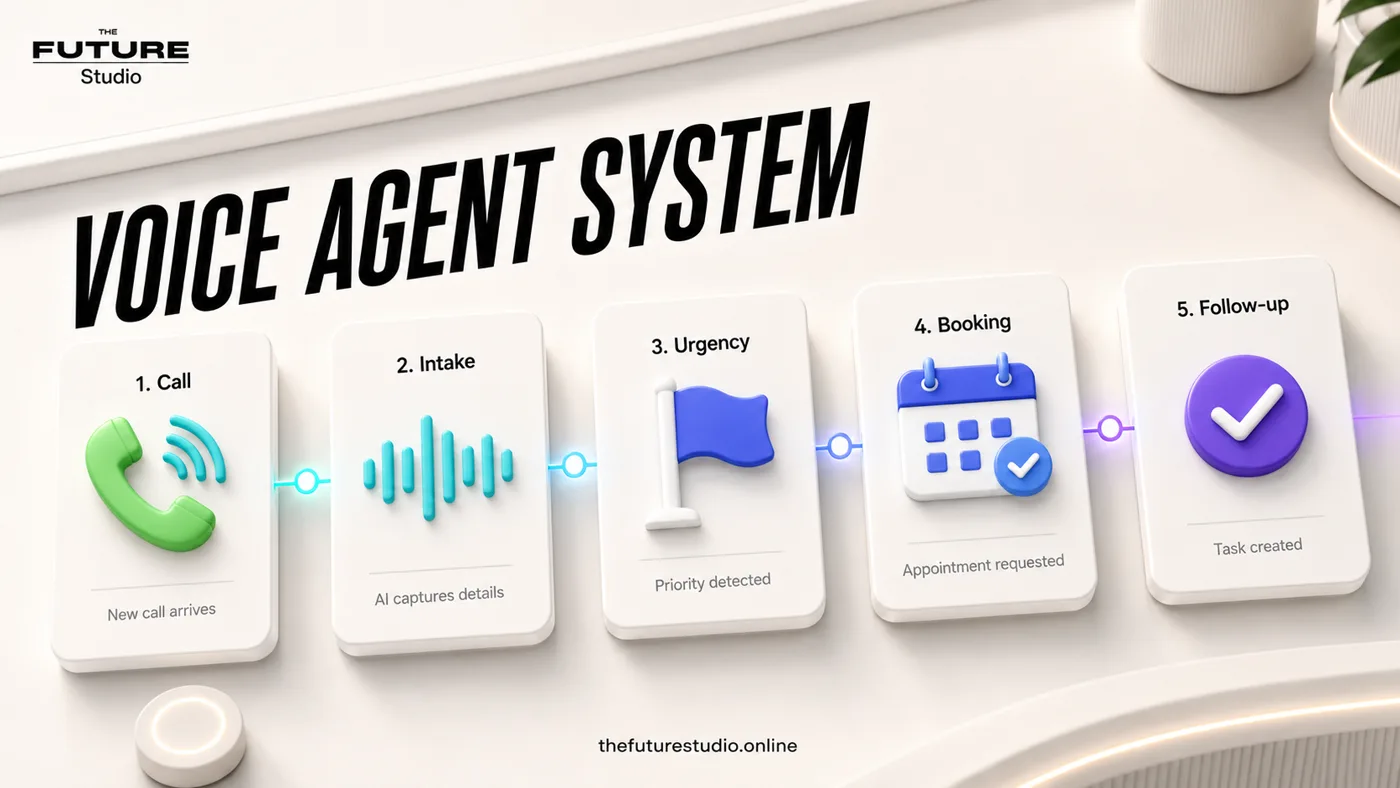
Make every call actionable
Use voice AI to capture booking intent, route requests, and protect staff time.
Recommended path
Connect this page to the right system
Each page exists for a distinct search intent and should move the visitor toward the right workflow, service page, or demo path.
Search intent
When voice AI is useful for booking
Voice AI is useful when businesses receive calls they cannot answer quickly enough. Clinics, service companies, med spas, legal offices, restaurants, and appointment-based teams all lose value when calls go unanswered.
The agent should capture the caller's goal, preferred time, contact details, and urgency level, then move the request into the right next step.
It is most useful when connected to calendar rules, staff alerts, CRM notes, and follow-up messages.
Boundaries
What the agent should not promise
A voice agent should not promise availability unless the calendar rules support it. It should not handle emergencies, clinical advice, legal advice, or sensitive decisions without human review.
The safer model is request, confirm, route, and summarize. Full direct booking can come later once the workflow is stable.
This keeps the voice experience practical instead of overbuilt.
Workflow
A first voice booking flow
Start with missed call or inbound call, reason for call, preferred appointment time, new or returning customer, contact confirmation, staff summary, and follow-up.
If a slot is available and the business allows it, the agent can book directly. Otherwise it can send the request to staff and confirm that the team will respond.
Add reminders, reschedules, and reporting once the first call flow is tested.
Operating rules
Voice needs tighter confirmation than chat
Voice automation has less room for ambiguity than text. The agent needs to repeat critical details, confirm the caller's phone number, and avoid promising a booking unless the calendar rule is certain. A request-and-confirm model is usually the safer first version.
The call summary should include why the person called, the requested appointment type, preferred time, urgency language, whether the caller accepted a follow-up message, and the recommended next action for staff.
Measure call answer rate, missed-call recovery, booking requests, confirmed appointments, escalation rate, and abandoned calls. Those numbers show whether the agent is helping callers or only adding another layer.
Example workflow
How this works in a real business
In daily operation, the value comes from turning an incomplete message into an action. For this topic, the system should organize caller name, callback number, appointment type, preferred time, urgency wording, permission for follow-up, and staff task summary and expose the next step.
People step in when there is emergencies, sensitive requests, unavailable appointment types, payment issues, custom scheduling, complaints, and low-confidence call summaries. The AI does not try to finish every conversation; it prepares a reviewable handoff.
The initial build should be a request-and-confirm call flow that captures booking intent, repeats critical details, and creates a staff task before direct booking is enabled. That keeps the project measurable and prevents the page or system from becoming generic.
Why The Future Studio
Built as a system, not a loose AI tool
These systems are built with portable logic: they can serve Panama where that matters, but they do not trap the brand inside one market.
For this intent, the value is solving callers expect a clear answer quickly, but staff may be unavailable and a bad voice agent can create confusion faster than a chat agent with rules the team can review, approve, and improve.
Quality is validated through answered calls, missed-call recovery, booking requests, confirmed appointments, escalation rate, and abandoned calls. That makes the page more useful for Google and more useful for sales.
Workflow map
The process should show data, limits, and the next action
This visual uses the existing proof assets to show how the request becomes an operating process: first caller name, callback number, appointment type, preferred time, urgency wording, permission for follow-up, and staff task summary, then rules for emergencies, sensitive requests, unavailable appointment types, payment issues, custom scheduling, complaints, and low-confidence call summaries, and finally measurement through answered calls, missed-call recovery, booking requests, confirmed appointments, escalation rate, and abandoned calls.
FAQ
Common questions
Can an AI voice agent book appointments?
Yes, when calendar rules and business approvals are clear.
Can it handle missed calls?
Yes. Missed-call follow-up is often the safest first voice automation.
Should it replace the front desk?
No. It should support repetitive call handling and route important calls to people.
Can it work with WhatsApp follow-up?
Yes. A call can trigger a WhatsApp or SMS follow-up with the next step.
Related pages
Explore the related cluster
Next step
Map the first workflow that needs to work
Book a free AI systems demo with The Future Studio. We will map the workflow, the boundaries, and the smallest useful system to build first.